Data · Future of live music
Festival risk: weather, disruption and insurance
Hazard, disruption, loss, insurance and modeled exposure are five different numbers. Most coverage blends them. This observatory keeps each one in its own row, with its own source and its own country.
In short
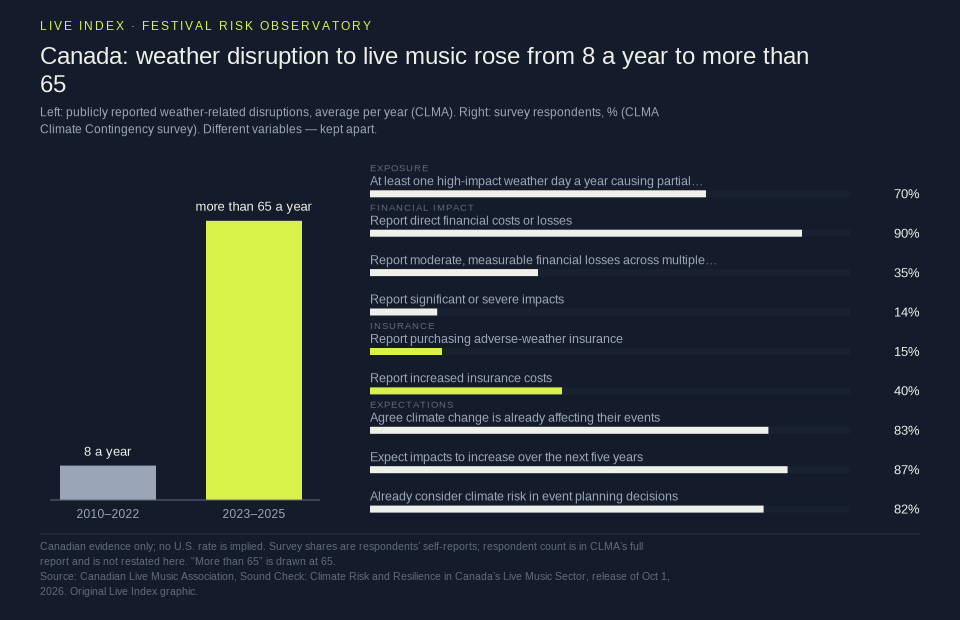
The clearest new evidence is Canadian. The Canadian Live Music Association reported on October 1, 2026 that publicly reported weather-related disruptions to live music events rose from an average of 8 a year in 2010–2022 to more than 65 a year in 2023–2025. Seventy percent of its survey respondents had at least one high-impact weather day a year causing partial or full cancellation, 90% reported direct costs — and only 15% bought adverse-weather insurance. None of this is a U.S. rate. In the U.S., Live Index records 2 verified weather cancellations, including Bonnaroo 2025 and the final Free Press Summer Fest day in 2017; that is a verification record, not a trend.
Lead figure · Two variables, one country
Canada’s reported weather disruptions rose eightfold, the CLMA says — most organisers report costs, few insure
The left panel counts events the CLMA found publicly reported as disrupted by weather; it is a count of reported disruptions, not of storms, and reporting itself may have grown. The right panel is the CLMA’s Climate Contingency survey: respondents describing their own experience. The study’s respondent count and definitions are in the CLMA’s full report; percentages here are as stated in its release.
| Measure | Value | Group | Kind |
|---|---|---|---|
| Publicly reported weather-related disruptions, average per year, 2010–2022 | 8 | Disruption frequency | Reported count |
| Publicly reported weather-related disruptions, average per year, 2023–2025 | more than 65 | Disruption frequency | Reported count |
| At least one high-impact weather day a year causing partial or full cancellation | 70% | Exposure | Survey |
| Report direct financial costs or losses | 90% | Financial impact | Survey |
| Report moderate, measurable financial losses across multiple events | 35% | Financial impact | Survey |
| Report significant or severe impacts | 14% | Financial impact | Survey |
| Report purchasing adverse-weather insurance | 15% | Insurance | Survey |
| Report increased insurance costs | 40% | Insurance | Survey |
| Agree climate change is already affecting their events | 83% | Expectations | Survey |
| Expect impacts to increase over the next five years | 87% | Expectations | Survey |
| Already consider climate risk in event planning decisions | 82% | Expectations | Survey |
| Modeled economic value at risk to 2040 (central estimate; range C$1.2–3.0 billion) | about C$1.8 billion | Modeled value at risk | Modeled |
Six variables, never one number
| Variable | What it describes | Measure | Evidence |
|---|---|---|---|
| Reported disruption | How often weather publicly disrupted an event | 8 a year (2010–2022) → more than 65 a year (2023–2025) | Count of publicly reported events, Canada |
| Exposure | Whether an organisation had a high-impact weather day | 70% of respondents, at least one a year with partial or full cancellation | Survey, Canada |
| Financial impact | Whether weather cost money | 90% direct costs or losses; 35% moderate; 14% significant or severe | Survey, Canada |
| Insurance | Whether cover was bought, and what it cost | 15% buy adverse-weather insurance; 40% report higher insurance costs | Survey, Canada |
| Value at risk | Economic value exposed in future | C$1.2–3 billion to 2040 (central about C$1.8 billion) | Model projection — not a realized loss |
| Verified cancellation | A named U.S. edition stopped by weather, in the organiser’s words | 2 records | Live Index registers — not a rate |
A modeled value at risk is a projection of what could be exposed; it is not money lost. A rise in insurance cost reported by respondents is not a premium index. A storm is a hazard; a cancellation is a decision. Keeping them apart is what makes each one usable.
Verified U.S. weather cancellations in Live Index records
| Date | Edition | Place | Outcome | Stated reason | Source |
|---|---|---|---|---|---|
| 2017-06-04 | Free Press Summer Fest 2017 | Houston, Texas | Second day called off | The second day of the 2017 edition was called off after flash-flood warnings; it was the festival's final edition. | Houstonia, via the Live Index Houston festival archive |
| 2025-06-13 | Bonnaroo Music & Arts Festival 2025 | Manchester, Tennessee | Cancelled (during the event) | Severe weather. After heavy rain on the first full day, organisers issued an evacuation notice and cancelled the remainder of the festival, writing that they were “beyond gutted.” | Billboard, 2025-06-13 |
For every verified U.S. cancellation, hiatus and discontinuation regardless of cause, see the Festival Cancellation Register. For what cancellation policies actually pay, see what festival cancellation insurance covers; for the cost structure that turns a bad weekend into a failed festival, why music festivals get canceled.
Questions to put to a weather plan
Not a safety determination and not legal or insurance advice. The CLMA’s own toolkit says its resources do not replace site-specific operational planning, professional meteorological advice, legal advice or insurance advice. These are the questions the evidence above makes unavoidable:
- Which weather conditions trigger a hold, a delay, an evacuation — and who decides?
- Does the cancellation policy, if any, cover adverse weather as written, and on what basis does it pay (costs, gross revenue, profit)?
- What is owed to ticket buyers on a partial day, and has that been stated before the sale?
- Which costs are committed before the on-sale and cannot be recovered?
- What did the last disrupted edition cost, and is that figure written down?
Read the analysis: Is extreme weather disrupting more live music?
Source ledger
Each source with its publisher, date, evidence type and the population it describes. Retrieved and checked 2026-11-23.
- [1]Canadian Live Music Association Releases National Project on Climate Risk to Canada's Live Music Sector
Canadian Live Music Association (CLMA) · 2026-10-01 · Survey (self-reported)
Scope: Canada; live music events and businesses; publicly reported disruptions 2010–2025, CLMA Climate Contingency survey respondents, climate projections to 2040. Not U.S. evidence
- [2]Climate Contingency Roadmap and Toolkit
Canadian Live Music Association (CLMA) · 2026-10-01 · Count reported by publisher
Scope: Canada; report download and preparedness toolkit with its own limits of use
- [3]The Festival Cancellation Register: 2025–2027
Live Index · 2026-09-02 · Live Index register
Scope: Verified U.S. festival cancellations, hiatuses and discontinuations; a verification record, not a census — no rate may be computed
- [4]Houston festival history archive
Live Index · 2026-11-22 · Live Index register
Scope: Free Press Summer Fest and Day for Night editions with per-event sources