Live Index — The Future of Live Music
How does AI recommend concerts? Where assistants get listings — and why independent shows go missing
An assistant can only recommend a show it can reach. The question for independent music is not whether AI likes small rooms, but whether small rooms publish in a form any machine can read — and who sets the terms on the listings that do.
- Authors
- Published
- Updated
In short
An AI assistant can recommend only concerts it can reach: listings in its training data, pages its search tool retrieves at the time of asking, or a feed it is licensed to use. Concert facts originate with artists, venues and promoters and travel through venue websites, ticketing platforms and aggregators, each on its own terms. A show published only as an image flyer, a social post or a calendar without machine-readable event data is harder for any automated system to find. In Live Index’s first lawful capture of official calendars, 13 of 67 audited venues yielded machine-readable listings — a measure of calendars, not of which venues have shows.
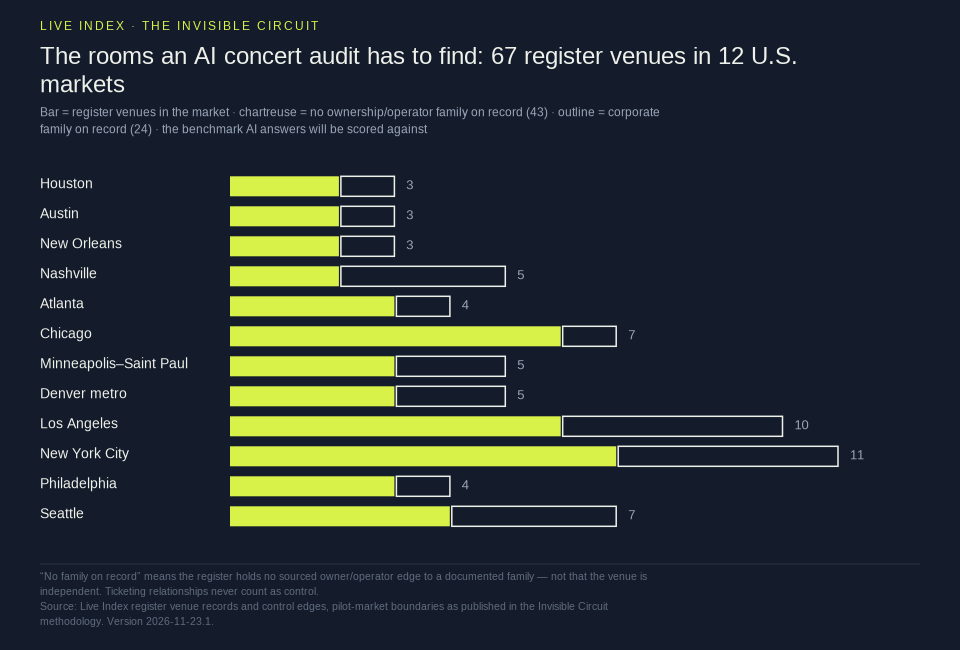
Lead figure · The audit’s denominator
Before scoring any AI answer, fix the list of rooms it should find
| Market | Register venues | Corporate family on record | No family on record | Official website on record |
|---|---|---|---|---|
| Houston | 3 | 1 | 2 | 3 |
| Austin | 3 | 1 | 2 | 3 |
| New Orleans | 3 | 1 | 2 | 3 |
| Nashville | 5 | 3 | 2 | 5 |
| Atlanta | 4 | 1 | 3 | 4 |
| Chicago | 7 | 1 | 6 | 7 |
| Minneapolis–Saint Paul | 5 | 2 | 3 | 5 |
| Denver metro | 5 | 2 | 3 | 5 |
| Los Angeles | 10 | 4 | 6 | 10 |
| New York City | 11 | 4 | 7 | 11 |
| Philadelphia | 4 | 1 | 3 | 4 |
| Seattle | 7 | 3 | 4 | 7 |
Three routes by which a listing reaches an assistant
In general terms, a conversational assistant has three ways to know that a concert exists. It may have seen the listing in the text it was trained on, which is a snapshot that ages from the day it was taken. It may retrieve pages through a search tool when the question is asked, in which case it depends on what is published, crawlable and returned for that query. Or it may be connected to a structured feed or developer API, which is governed by a licence. Each route favours listings that are published early, in plain text or structured data, on pages that are allowed to be read. None of those conditions concerns how good the show is.
Live Index does not claim to know how any particular assistant weights these routes, and makes no claim here about any platform’s preferences. What can be tested from outside is narrower and more useful: given a city and a date, does an assistant’s answer match the shows that official venue calendars actually list? That is what the Invisible Circuit is built to measure. 1
Who owns concert listing data?
The facts of a show — performer, venue, date, time — originate with the artist, the venue and the promoter. They are then distributed through the venue’s own website, through the ticketing company that sells the show and through aggregators, and each channel sets its own terms for reuse. No public source establishes a general rule that one party owns all of it; who may reuse a particular listing depends on the terms of the site or service it came from and the contracts behind it, which are rarely published.
Developer access makes the terms concrete. VenuePilot’s public API, for example, is a read-only, account-scoped event feed that requires an application id provisioned by a VenuePilot account manager. 2 Ticketing platforms’ developer programmes likewise require a key and acceptance of their terms. For the Invisible Circuit, Live Index reads only official venue calendars where robots.txt permits, holds every individual listing until that site’s terms have been reviewed, and uses no API it has not been granted. 13
Why an independent show may not appear
There is no single cause, and the reasons below are conditions that make a listing harder to reach, not measured frequencies:
- The calendar is an image, a PDF or a social post, so the date and performer exist only as pixels or inside a closed platform.
- The venue’s pages carry no schema.org Event data, so a machine has to guess which text is a show.
- The site blocks automated readers in robots.txt or behind a bot challenge — a legitimate choice that also blocks discovery.
- The listing lives on a ticketing page under a different venue name, or the room trades under several names.
- The show was announced after the assistant’s training snapshot and its search tool did not retrieve it.
Live Index’s 2026-11-23 capture shows how uneven machine-readable calendars are. Across 67 audited venues in 12 U.S. markets, 150 dated concert listings were captured at 13 venues in 9 markets for the window starting 2026-11-22. Robots.txt refused 8 calendar pages, one returned a bot challenge and 3 returned errors. A venue with no captured listings is one whose calendar Live Index could not read from eligible sources — not a venue without shows, and not a venue AI “cannot see”. 1
The rooms the audit will score against
The figure above is the audit’s denominator: 67 register venues across twelve pilot markets, of which 24 have a sourced owner or operator edge to a documented corporate family and 43 have none on record. “None on record” is not a finding of independence; it means the register has not established control. Fixing this list before any AI answer is scored is what stops an audit from grading assistants against whatever its authors happened to remember. See the venue register and the ownership atlas. 3
What the Invisible Circuit will test — and what it will not claim
Prompts are fixed, balanced across markets and dates, and versioned. Each reply is checked against verified dated listings; a recommended show that cannot be matched is recorded as unmatched, never counted as true. Runs through a provider’s API are labelled as API benchmarks and kept apart from answers a person records by hand from a consumer app, because the two are not the same experience. No provider is ranked until enough reviewed runs exist to support it, and the index stays out of search until its evidence, rights and quality gates pass. As of this writing, no AI answer has been scored. 1
For venues: making a calendar readable without gaming anything
Google’s own guidance for its AI Overviews and AI Mode is that there are no additional technical requirements beyond being indexed and eligible for a snippet in Search, and that ordinary SEO fundamentals — crawlable pages, internal links — still apply. 4 Its event documentation asks for each event to have its own page with its own markup, rather than markup on pages that list many events. 5 For a venue, the practical version is modest:
- Give every show its own page with performer, date, local start time and venue name in plain text.
- Add schema.org Event markup to those single-show pages, including status changes for cancelled or rescheduled dates.
- Link each show from the calendar and to the official ticket page.
- Decide deliberately what robots.txt allows; blocking all automated readers also blocks discovery.
Research notes and limitations
The capture describes official venue calendars that publish structured event data and permit automated reading; it does not describe all shows in a market. The venue denominator is the Live Index register in twelve pilot markets (67 venues), not a census. No AI replies have been scored, so this page makes no claim about assistant accuracy or bias.
References
- 01Live Index, The Invisible Circuit — methodology preview and official-calendar capture of 2026-11-23 (aggregate counts; individual listings held pending terms review). /data/ai-concert-discovery/methodology
- 02VenuePilot, Public GraphQL API documentation (retrieved 2026-11-23). docs.venuepilot.com/public
- 03Live Index, data standards and crawler disclosure; venue register. /standards/data · /industry/venues
- 04Google Search Central, “AI features and your website” (retrieved 2026-11-23). developers.google.com/search/docs/appearance/ai-features
- 05Google Search Central, “Event structured data” (retrieved 2026-11-23). developers.google.com/search/docs/appearance/structured-data/event
Publication record
The structured record for this document. Classification is drawn from the Live Index controlled vocabulary so relationships between people, subjects, places and measurements stay consistent across the platform.
- Content type
- Analysis
- Primary topic
- Artificial Intelligence
- Secondary topics
- Data OwnershipMusic TechnologyVenue Economics
- Themes
- AccessIndependenceInfrastructure
- Methodology
- What we measure
Corrections and revisions
No corrections have been issued for this document. Substantive errors are corrected on this page, dated and retained.
Cite this research
- Plain
- Live Index Research Desk, "How does AI recommend concerts? Where assistants get listings — and why independent shows go missing", Live Index, November 23, 2026, https://liveindex.io/research/how-ai-assistants-find-concerts
- APA
- Desk, L. I. R. (2026, November 23). How does AI recommend concerts? Where assistants get listings — and why independent shows go missing. Live Index. https://liveindex.io/research/how-ai-assistants-find-concerts
- Chicago
- Live Index Research Desk. "How does AI recommend concerts? Where assistants get listings — and why independent shows go missing." Live Index, November 23, 2026. https://liveindex.io/research/how-ai-assistants-find-concerts.
- BibTeX
- @online{research-how-ai-assistants-find-concerts-2026, author = {Live Index Research Desk}, title = {How does AI recommend concerts? Where assistants get listings — and why independent shows go missing}, organization = {Live Index}, date = {2026-11-23}, url = {https://liveindex.io/research/how-ai-assistants-find-concerts} }