Live Index — The Future of Live Music
Is extreme weather disrupting more live music? What Canada’s climate study measured — and what it can’t tell U.S. festivals
The best new evidence on weather and live music comes from Canada, and it is striking. It is also Canadian, partly self-reported and partly modeled. Read carefully, it separates five things that coverage of cancelled festivals usually runs together.
- Authors
- Published
- Updated
In short
The Canadian Live Music Association reported on October 1, 2026 that publicly reported weather-related disruptions to live music events in Canada rose from an average of 8 a year in 2010–2022 to more than 65 a year in 2023–2025. Seventy percent of its survey respondents report at least one high-impact weather day a year causing partial or full cancellation and 90% report direct costs, but only 15% buy adverse-weather insurance. Its estimate of C$1.2–3.0 billion in value at risk to 2040 is a model, not a loss. None of these figures is a U.S. rate.
Lead figure · Cost versus cover
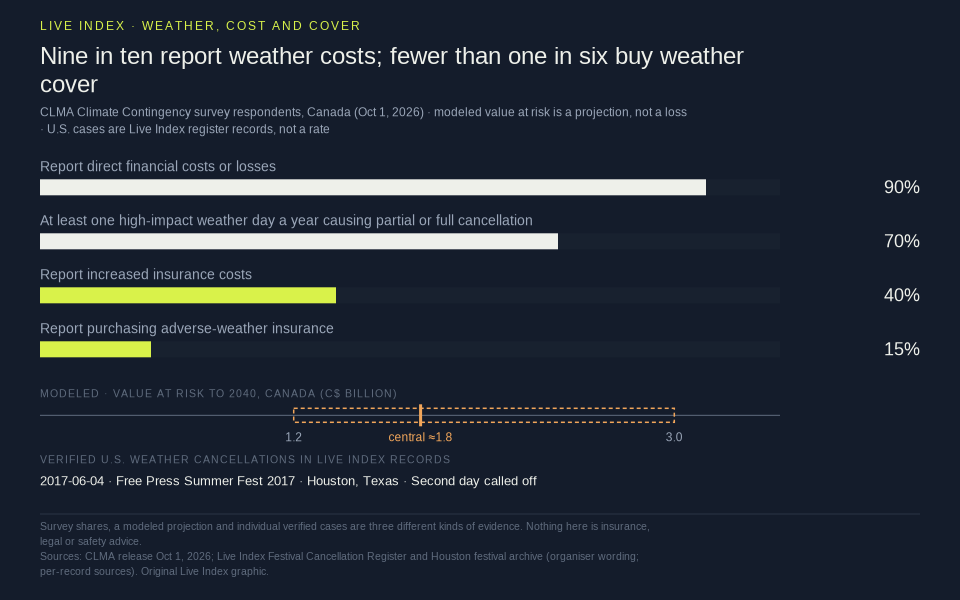
Weather costs are widespread; weather insurance is not
| Measure or case | Value | Kind | Scope |
|---|---|---|---|
| At least one high-impact weather day a year causing partial or full cancellation | 70% | Survey | CLMA Climate Contingency survey respondents, Canada |
| Report direct financial costs or losses | 90% | Survey | CLMA Climate Contingency survey respondents, Canada |
| Report purchasing adverse-weather insurance | 15% | Survey | CLMA Climate Contingency survey respondents, Canada |
| Report increased insurance costs | 40% | Survey | CLMA Climate Contingency survey respondents, Canada |
| Modeled economic value at risk to 2040 (central estimate; range C$1.2–3.0 billion) | about C$1.8 billion | Modeled | Canadian music-event and festival economic value, projection to 2040 — not realized losses |
| Free Press Summer Fest 2017 (2017-06-04) | Second day called off | Verified case | Houston, Texas |
| Bonnaroo Music & Arts Festival 2025 (2025-06-13) | Cancelled (during the event) | Verified case | Manchester, Tennessee |
What the Canadian study found
The Canadian Live Music Association’s study, “Sound Check: Climate Risk and Resilience in Canada’s Live Music Sector,” draws on its Climate Contingency survey, national disruption data and climate projections to the 2030s and 2050s. Its release reports that publicly reported weather-related disruptions to live music events rose from an average of 8 a year between 2010 and 2022 to more than 65 a year between 2023 and 2025 — an eightfold increase, in the association’s words. 1
Among survey respondents, 70% report at least one high-impact weather day a year that leads to partial or full cancellation; 90% report direct financial costs or losses; 35% report moderate, measurable losses across multiple events and 14% significant or severe impacts. Only 15% report buying adverse-weather insurance, while 40% report higher insurance costs. Large majorities say climate change already affects their events (83%), expect impacts to grow over five years (87%) and already weigh climate risk in planning (82%). 1
Five variables that are usually blended
Coverage of a cancelled festival tends to treat “the weather” as one number. The study, read closely, offers several, and they should not be swapped for each other:
- Reported disruption — a count of events found publicly reported as disrupted. It can rise because weather worsened, because more events were held, or because reporting improved.
- Exposure — whether an organisation experienced a high-impact weather day, as respondents describe it.
- Financial impact — whether, and how badly, weather cost money, again self-reported.
- Insurance — whether cover was bought and what it cost; a share of respondents, not a premium index.
- Modeled value at risk — C$1.2 billion to C$3.0 billion of Canadian music-event and festival economic value between now and 2040, with a central estimate of about C$1.8 billion. A projection of what could be exposed, not a realized loss.
The lead figure sets the cost and cover measures next to each other because the gap between them is the study’s sharpest finding: weather costs are nearly universal among respondents, weather insurance is not. The full set is charted on the Festival Risk Observatory. 2
What the U.S. record shows instead
There is no comparable U.S. study in the sources here, and Canada’s rates cannot be transferred. What Live Index can show is individual verified cases in organisers’ own words: Free Press Summer Fest 2017 (second day called off, 2017-06-04); Bonnaroo Music & Arts Festival 2025 (cancelled (during the event), 2025-06-13). Those are entries in a verification register and the Houston festival archive, not a sample: no rate or trend can be computed from them. 34
The Houston case is instructive precisely because it is documented end to end: the 2017 Free Press Summer Fest lost its second day to flash-flood warnings, and it was the festival’s final edition. The record shows the sequence; it does not establish that weather alone ended the festival, and Live Index does not claim it did.
Why the insurance gap matters
Cancellation cover pays documented, otherwise irrecoverable costs — and lost revenue or profit only where bought on that basis — when a covered cause stops an event. Adverse weather that makes an outdoor event impossible or unsafe is a standard covered peril in the policy materials Live Index has reviewed, subject to the wording. 5 A sector where nine in ten respondents report weather costs and fewer than one in six buy weather cover is carrying the risk on its own balance sheets. For the policy mechanics, see what festival cancellation insurance covers; for the cost structure that makes one bad weekend fatal, why music festivals get canceled.
Research notes and limitations
CLMA figures are restated from its October 1, 2026 release; the respondent count and definitions are in its full report, which Live Index has not transcribed. All CLMA measures describe Canada. U.S. cases are verification records, not a sample, and support no rate.
References
- 01Canadian Live Music Association, “Canadian Live Music Association Releases National Project on Climate Risk to Canada’s Live Music Sector,” October 1, 2026. www.canadianlivemusic.ca/news/climate-contingency-roadmap-release
- 02Canadian Live Music Association, Climate Contingency Roadmap, report and toolkit. www.canadianlivemusic.ca/climate-contingency-roadmap
- 03Live Index, The Festival Cancellation Register: 2025–2027 (organiser statements and named reporting per record). /research/festival-cancellation-register-2025-2027
- 04Live Index, Houston festival history archive (Free Press Summer Fest 2017, sourced to Houstonia). /projects
- 05Live Index, What Does Festival Cancellation Insurance Actually Cover? (Hiscox, Beazley and Marsh policy materials). /research/festival-cancellation-insurance
Publication record
The structured record for this document. Classification is drawn from the Live Index controlled vocabulary so relationships between people, subjects, places and measurements stay consistent across the platform.
- Content type
- Analysis
- Primary topic
- Festivals
- Secondary topics
- Festival EconomicsPublic Space
- Themes
- Infrastructure
- Methodology
- What we measure
Corrections and revisions
No corrections have been issued for this document. Substantive errors are corrected on this page, dated and retained.
Cite this research
- Plain
- Live Index Research Desk, "Is extreme weather disrupting more live music? What Canada’s climate study measured — and what it can’t tell U.S. festivals", Live Index, November 23, 2026, https://liveindex.io/research/extreme-weather-live-music-disruption-evidence
- APA
- Desk, L. I. R. (2026, November 23). Is extreme weather disrupting more live music? What Canada’s climate study measured — and what it can’t tell U.S. festivals. Live Index. https://liveindex.io/research/extreme-weather-live-music-disruption-evidence
- Chicago
- Live Index Research Desk. "Is extreme weather disrupting more live music? What Canada’s climate study measured — and what it can’t tell U.S. festivals." Live Index, November 23, 2026. https://liveindex.io/research/extreme-weather-live-music-disruption-evidence.
- BibTeX
- @online{research-extreme-weather-live-music-disruption-evidence-2026, author = {Live Index Research Desk}, title = {Is extreme weather disrupting more live music? What Canada’s climate study measured — and what it can’t tell U.S. festivals}, organization = {Live Index}, date = {2026-11-23}, url = {https://liveindex.io/research/extreme-weather-live-music-disruption-evidence} }