Live Index — The Future of Live Music
Can AI book a concert tour? What machines can — and cannot — replace
Booking a tour is part logistics, part arithmetic and part judgement. Software is moving into the first two. The evidence so far is a vendor’s description and practitioners’ views — not an independent test — and it points to a clear line.
- Authors
- Published
- Updated
In short
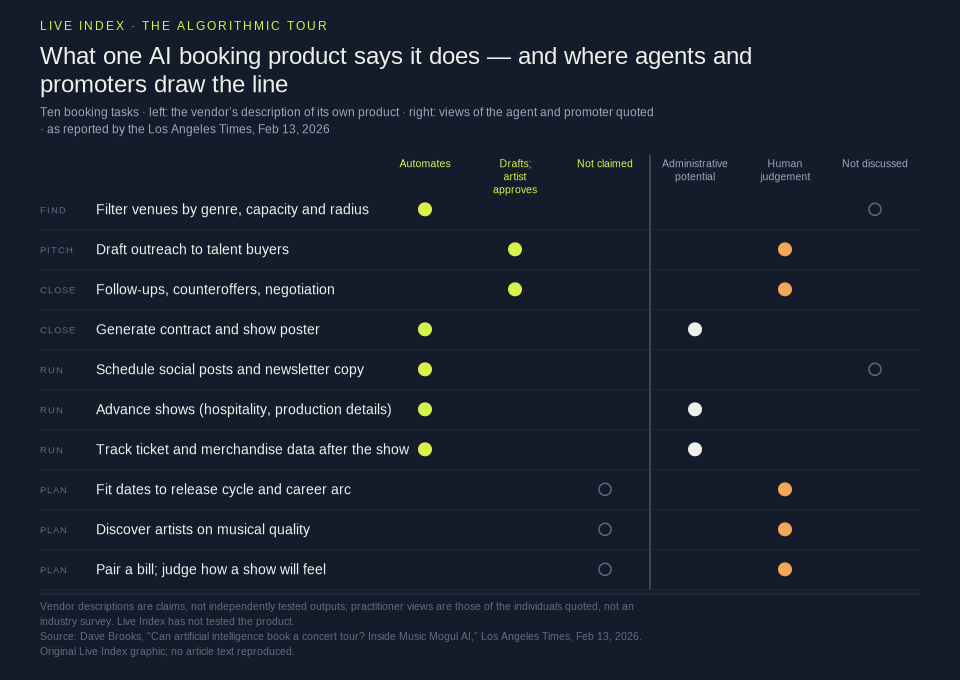
Software can already filter venues, draft pitches and contracts, schedule promotion and advance shows; one vendor described in the Los Angeles Times says its product does all of these, with the artist approving every outgoing message. What the agent and promoter quoted say it cannot do is the judgement: fitting dates to a release cycle, choosing a smaller room or a support slot, discovering an artist on the music alone, and pairing a bill. No independent test of such a system’s outcomes is publicly available. Whether a booked date pays is arithmetic either way — and the Live Index Tour Builder now shows when a date fails.
Lead figure · Claims, not tests
Ten booking tasks: what the software is said to do, and what people say it cannot
| Task | Stage | Vendor description | Practitioner view | What was reported |
|---|---|---|---|---|
| Filter venues by genre, capacity and radius | Find | Automates | Not discussed | Vendor describes a proprietary venue, festival and promoter database filtered by genre, capacity and geography, typically a 350-mile radius. |
| Draft outreach to talent buyers | Pitch | Drafts; artist approves | Human judgement | Vendor says every message needs artist approval before sending; the agent quoted worries automated pitches become invisible in flooded inboxes. |
| Follow-ups, counteroffers, negotiation | Close | Drafts; artist approves | Human judgement | Prepared by the software but never sent without human review, per the vendor; the agent quoted says reputation and context matter in negotiation. |
| Generate contract and show poster | Close | Automates | Administrative potential | Generated together once a show is booked, per the vendor; the agent sees potential in standardizing contracts. |
| Schedule social posts and newsletter copy | Run | Automates | Not discussed | Marketing module drafts and schedules posts and basic email copy, per the vendor. |
| Advance shows (hospitality, production details) | Run | Automates | Administrative potential | Management module advances by email, per the vendor. |
| Track ticket and merchandise data after the show | Run | Automates | Administrative potential | Feeds future routing and pricing, per the vendor; the agent names aggregating sales data as a fit for AI. |
| Fit dates to release cycle and career arc | Plan | Not claimed | Human judgement | The agent quoted: booking is long-term planning around releases, audience development and trajectory. The vendor offers optional human consulting. |
| Discover artists on musical quality | Plan | Not claimed | Human judgement | The promoter quoted books some artists with no released music, going on the music rather than data. |
| Pair a bill; judge how a show will feel | Plan | Not claimed | Human judgement | The promoter quoted: billing and feel are where AI stops and the human conversation starts. |
What the software is said to do
In February 2026 the Los Angeles Times described Music Mogul AI, built by the booking agent Brad Stewart of Stewart Entertainment in Charlotte, North Carolina. As reported, artists enter their goals and fees; the software filters a proprietary venue, festival and promoter database by genre, capacity and geography — typically within a 350-mile radius — and drafts outreach to talent buyers. Stewart is quoted saying nothing goes out without the artist’s approval, and that follow-ups and negotiations are prepared but not sent without review. Once a show is booked, the product generates a contract and a poster, schedules promotion, advances the show and tracks sales afterwards. 1
The article reports pricing of $300 a month per AI module, or about $8,000 a year for all three, and Stewart’s view that an agency usually needs an artist grossing at least $200,000 a year in live revenue to take them on full time. Those are the vendor’s figures and the vendor’s reading of the market. Live Index has not tested the product, and nothing in the reporting is an independent measure of how many shows it books or what they pay. 1
Where practitioners draw the line
The agent quoted, Avery McTaggart of TBA Agency, sees potential in the administrative side — organising offers, standardising contracts, aggregating sales data — but describes booking as long-term planning around an artist’s release cycle, audience development and career trajectory, and worries that automated pitches become invisible in inboxes already flooded with them. The promoter quoted, Kyle Wilkerson of Sid the Cat Presents, books some artists who have released no music online, going on the music rather than data, and puts the line at the conversation about how a show will feel and who it pairs with. 1
The lead figure sorts the ten tasks the article describes into what the vendor says the software does and what the practitioners say requires a person. The pattern is consistent: finding, drafting and running are where software claims ground; planning and taste are where nobody quoted claims it does. That is a description of one product and three people’s views, not a survey of the industry.
The part that is arithmetic either way
Whoever books a date — a person, a program, or both — it still has to work twice: for the promoter after show expenses and the artist payment, and for the artist after commissions, crew, lodging, per diems and travel. The Tour Builder now includes a break-even simulator that shows both waterfalls side by side and names the reason a date fails: the promoter cannot reach break-even inside the room’s capacity, the guarantee is carrying a thin house, or the artist’s road costs exceed what the deal can pay. It predicts nothing; the attendance is whatever you type. 2
That arithmetic is where routing software can genuinely help and genuinely mislead. A tool that ranks venues by fit is useful; a tool that implies demand it has not measured is not. For the algebra, see how many tickets a tour needs and concert break-even attendance; for one disclosed real budget, what it costs an independent band to tour.
What to ask of any AI booking product
- Whose name and domain do pitches go out under, and can the artist see every message before it is sent?
- Where does the venue and promoter database come from, and how current are its contacts and capacities?
- Does it estimate demand? If so, from what data, and has the estimate ever been checked against sales?
- Who owns the data the artist enters, and the sales data the system collects after shows?
- What happens to an offer the software negotiates if the buyer wants to speak to a person?
Research notes and limitations
The evidence is one news article describing one vendor and the views of one agent, one promoter and one client artist. Vendor statements are claims, not tested outputs. The Tour Builder simulator applies the reader’s own numbers to stated formulas and is not a forecast.
References
- 01Dave Brooks, “Can artificial intelligence book a concert tour? Inside Music Mogul AI,” Los Angeles Times, February 13, 2026. Paraphrased. www.latimes.com/entertainment-arts/music/story/2026-02-13/can-artificial-intelligence-book-concert-tour-inside-music-mogul-ai
- 02Live Index, Tour Builder and break-even simulator. /tools/tour-builder
Publication record
The structured record for this document. Classification is drawn from the Live Index controlled vocabulary so relationships between people, subjects, places and measurements stay consistent across the platform.
- Content type
- Analysis
- Primary topic
- Touring
- Secondary topics
- Music TechnologyArtist EconomicsIndependent Promoters
- Themes
- AccessIndependence
- Methodology
- What we measure
Corrections and revisions
No corrections have been issued for this document. Substantive errors are corrected on this page, dated and retained.
Cite this research
- Plain
- Live Index Research Desk, "Can AI book a concert tour? What machines can — and cannot — replace", Live Index, November 23, 2026, https://liveindex.io/research/can-ai-book-a-concert-tour
- APA
- Desk, L. I. R. (2026, November 23). Can AI book a concert tour? What machines can — and cannot — replace. Live Index. https://liveindex.io/research/can-ai-book-a-concert-tour
- Chicago
- Live Index Research Desk. "Can AI book a concert tour? What machines can — and cannot — replace." Live Index, November 23, 2026. https://liveindex.io/research/can-ai-book-a-concert-tour.
- BibTeX
- @online{research-can-ai-book-a-concert-tour-2026, author = {Live Index Research Desk}, title = {Can AI book a concert tour? What machines can — and cannot — replace}, organization = {Live Index}, date = {2026-11-23}, url = {https://liveindex.io/research/can-ai-book-a-concert-tour} }