Live Index — The Future of Live Music
Are ticket bots illegal? The BOTS Act, the REPS complaint and what is only alleged
Federal law does not ban software, resale or high prices. It bans getting around the controls ticket sellers use to enforce their limits — and selling what that produces. The government’s newest case is its largest, and every number in it is still an allegation.
- Authors
- Published
- Updated
In short
Yes, in a specific sense. The federal Better Online Ticket Sales (BOTS) Act prohibits circumventing a ticket issuer’s security measures, access controls or other technological controls used online to enforce ticket limits, and selling tickets obtained that way if the seller participated in, controlled or should have known about the violation. It covers events at venues seating more than 200. On October 15, 2026 the Justice Department, on referral from the FTC, sued the broker REPS & Company, alleging it bought more than 18.5 million tickets since 2022. Those figures are allegations; there has been no determination of liability.
Lead figure · Allegations labelled
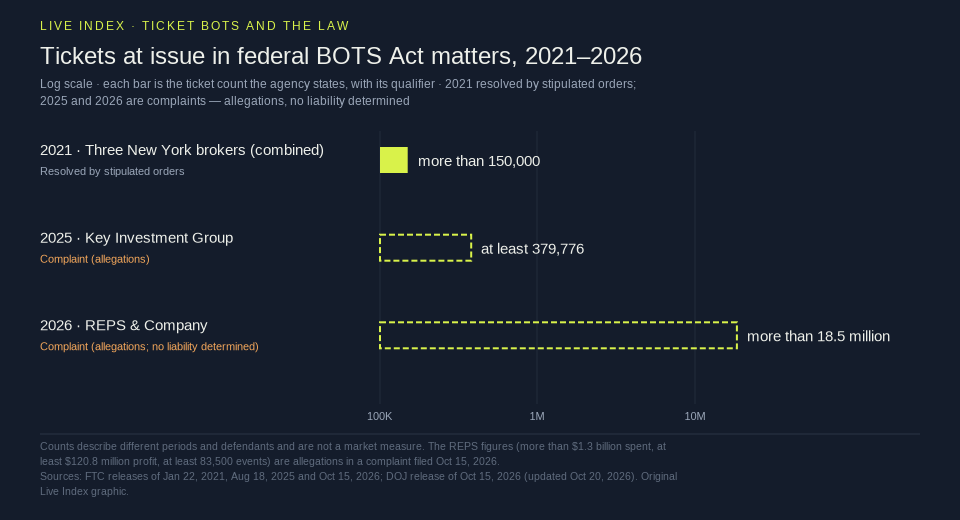
From more than 150,000 tickets to more than 18.5 million: federal bot cases, as alleged
| Year | Matter | Tickets | Period | Status |
|---|---|---|---|---|
| 2021 | Three New York brokers (combined) | more than 150,000 | Not stated in release | Resolved by stipulated orders |
| 2025 | Key Investment Group | at least 379,776 | Just over a year | Complaint (allegations) |
| 2026 | REPS & Company | more than 18.5 million | Since 2022 | Complaint (allegations; no liability determined) |
What the BOTS Act prohibits
The Better Online Ticket Sales Act, codified at 15 U.S.C. § 45c and enacted in 2016, does two things, as the FTC describes it. It prohibits circumventing a security measure, access control system or other technological control measure used online by a ticket issuer. And it prohibits selling, or offering to sell, an event ticket obtained through such a circumvention if the seller participated in, had the ability to control, or should have known about the violation. It applies to tickets for public concerts, theatre, sporting events and similar activities at venues with seating capacity of over 200. 1
Read narrowly, that is a law about controls. It does not, on the FTC’s description, make reselling a ticket illegal as such, cap resale prices or regulate fees — fee display is the subject of a separate FTC rule, in force since May 12, 2025, that requires the total price up front without capping it. 2
How enforcement has grown
The FTC brought its first BOTS Act cases on January 22, 2021, against three New York brokers it alleged had bought more than 150,000 tickets using automated software, concealed IP addresses and hundreds of fictitious Ticketmaster accounts. The matters were resolved by proposed stipulated orders with judgments of more than $31 million, partially suspended for inability to pay, so that the defendants were to pay about $3.7 million. 3
On March 31, 2025, Executive Order 14254 directed the FTC to rigorously enforce the BOTS Act and to work with state attorneys general. 4 In August 2025 the FTC sued Key Investment Group and affiliates, alleging at least 379,776 tickets bought from Ticketmaster in just over a year at a cost of nearly $57 million, including 273 tickets across 49 accounts for one Eras Tour concert with a six-ticket limit. 5
The REPS complaint: the largest yet, and still an allegation
On October 15, 2026, the Justice Department filed a complaint on the FTC’s referral, by a 2–0 Commission vote, in the Southern District of California against REPS & Company Inc. and three executives — CEO Ryan Pancheri, President Brian Archibald and COO Nicholas Totagrande — under the BOTS Act and the FTC Act. 67
The complaint alleges that since 2022 REPS bought more than eight tickets for at least 83,500 events, spent more than $1.3 billion to amass more than 18.5 million tickets and made at least $120.8 million in profit reselling them; it cites, as one example, 7,624 tickets bought with 1,300 accounts for a single 2023 Beyoncé Renaissance concert in Kansas City, generating $833,000 in profit. The Justice Department states that the claims are allegations only and that there has been no determination of liability; the FTC notes that the case will be decided by the court. 67
The FTC’s release describes the ticket issuers’ controls in general terms — quantity selectors capped at the limit and checks on accounts, cards, emails, phone numbers and IP addresses — and names Ticketmaster and AXS among the issuers using them. Live Index does not detail the methods the complaint alleges were used to defeat those controls, and publishes no guidance on doing so. For who controls those platforms, see who owns AXS and who owns Ticketmaster. 6
What about AI ticket-buying agents?
None of the sources here addresses AI shopping agents by name, and no court decision or agency guidance on them is among them. The statute’s test, as the FTC states it, is circumvention. An agent that buys within a seller’s posted limits and rules raises a different question from software that defeats them, and a seller’s own terms of use can be stricter than federal law. Anyone deploying such a tool should read the seller’s terms and take legal advice; this page is neither.
Why tickets sell out in minutes
Demand that exceeds capacity, inventory allocated before the public on-sale and automated buying all contribute. The enforcement record cannot apportion them: it describes what specific brokers are alleged to have done, not what share of any on-sale they took. For allocation, see where tickets go before general sale; for every dated event in this record, the Automated Ticketing Monitor.
Research notes and limitations
Figures from the 2025 and 2026 matters are allegations in complaints; the 2021 terms are as announced for proposed stipulated orders. Ticket counts describe different defendants and periods and are not a market measure. This page is not legal advice.
References
- 01Federal Trade Commission, Better Online Ticket Sales Act, 15 U.S.C. § 45c (statute page). www.ftc.gov/legal-library/browse/statutes/better-online-ticket-sales-act
- 02Federal Trade Commission, “FTC Rule on Unfair or Deceptive Fees to Take Effect May 12, 2025.” www.ftc.gov/news-events/news/press-releases/2025/05/ftc-rule-unfair-or-deceptive-fees-take-effect-may-12-2025
- 03Federal Trade Commission, “FTC Brings First-Ever Cases Under the BOTS Act,” January 22, 2021. www.ftc.gov/news-events/news/press-releases/2021/01/ftc-brings-first-ever-cases-under-bots-act
- 04Executive Order 14254, “Combating Unfair Practices in the Live Entertainment Market,” March 31, 2025. www.whitehouse.gov/presidential-actions/2025/03/combating-unfair-practices-in-the-live-entertainment-market
- 05Federal Trade Commission, “FTC Takes Action Against Ticket Resellers for Using Illegal Tactics to Bypass Ticket Limit Protections,” August 18, 2025. www.ftc.gov/news-events/news/press-releases/2025/08/ftc-takes-action-against-ticket-resellers-using-illegal-tactics-bypass-ticket-limit-protections
- 06Federal Trade Commission, “FTC Sues Ticket Broker Over Unlawful Tactics Used to Buy Millions of Tickets to Popular Live Events,” October 15, 2026. www.ftc.gov/news-events/news/press-releases/2026/10/ftc-sues-ticket-broker-over-unlawful-tactics-used-buy-millions-tickets-popular-live-events
- 07U.S. Department of Justice, “Justice Department Files Complaint Against California Ticket Broker…,” October 15, 2026 (updated October 20, 2026). www.justice.gov/opa/pr/justice-department-files-complaint-against-california-ticket-broker-using-unlawful-tactics
Publication record
The structured record for this document. Classification is drawn from the Live Index controlled vocabulary so relationships between people, subjects, places and measurements stay consistent across the platform.
- Content type
- Analysis
- Primary topic
- Ticketing
- Secondary topics
- ResaleTicket Pricing
- Themes
- AccessAffordability
- Methodology
- What we measure
Corrections and revisions
No corrections have been issued for this document. Substantive errors are corrected on this page, dated and retained.
Cite this research
- Plain
- Live Index Research Desk, "Are ticket bots illegal? The BOTS Act, the REPS complaint and what is only alleged", Live Index, November 23, 2026, https://liveindex.io/research/ticket-bots-bots-act-explained
- APA
- Desk, L. I. R. (2026, November 23). Are ticket bots illegal? The BOTS Act, the REPS complaint and what is only alleged. Live Index. https://liveindex.io/research/ticket-bots-bots-act-explained
- Chicago
- Live Index Research Desk. "Are ticket bots illegal? The BOTS Act, the REPS complaint and what is only alleged." Live Index, November 23, 2026. https://liveindex.io/research/ticket-bots-bots-act-explained.
- BibTeX
- @online{research-ticket-bots-bots-act-explained-2026, author = {Live Index Research Desk}, title = {Are ticket bots illegal? The BOTS Act, the REPS complaint and what is only alleged}, organization = {Live Index}, date = {2026-11-23}, url = {https://liveindex.io/research/ticket-bots-bots-act-explained} }