
Promotion · Historical
Sol Hurok
booking and promotion impresario, Hurok Attractions
Sol Hurok (1888–1974) was an independent booking and promotion impresario whose institutional archive documents the practical machinery of international performance tours.
Last updated 2026-10-25
In short
Sol Hurok is documented here as a historical booking and promotion impresario at Hurok Attractions, not a current employee. Institutional records expose booking, publicity and international tour logistics as distinct operating responsibilities. Sol Hurok (1888–1974) was an independent booking and promotion impresario whose institutional archive documents the practical machinery of international performance tours.
Quick facts
- Historical role
- booking and promotion impresario
- Organisation
- Hurok Attractions
- Primary category
- Promotion
- Known for
- National Ballet Russe de Monte Carlo tours described in the Hurok finding aid.; Gallo collection documents the Original Ballet Russe transition and Cuba transport arrangements.; Sadler Wells touring cited in NYPL’s agency history.
- Last verified
- 2026-10-25
- Historical relationships
- Hurok Attractions
Historical account
Sol Hurok (1888–1974) was an independent booking and promotion impresario whose institutional archive documents the practical machinery of international performance tours. The New York Public Library identifies Hurok Attractions as his agency and preserves records dated 1906–1974, concentrated in 1959–1964. This historical record describes presentation and tour organization, not ownership of the buildings in which visiting companies performed.
NYPL’s Hurok Attractions finding aid describes early representation of performers including Marian Anderson and Martha Graham and a progression into touring ballet companies. It identifies four national Ballet Russe de Monte Carlo tours during the 1930s and a 1949 Sadler Wells tour as part of the development of international bookings and publicity campaigns. The surviving materials include publicity and press surrounding Kirov Ballet visits in 1961 and 1964. Their scope makes advance communication and company movement visible, rather than reducing an impresario’s work to the names on a bill.
Why Sol Hurok matters in live music
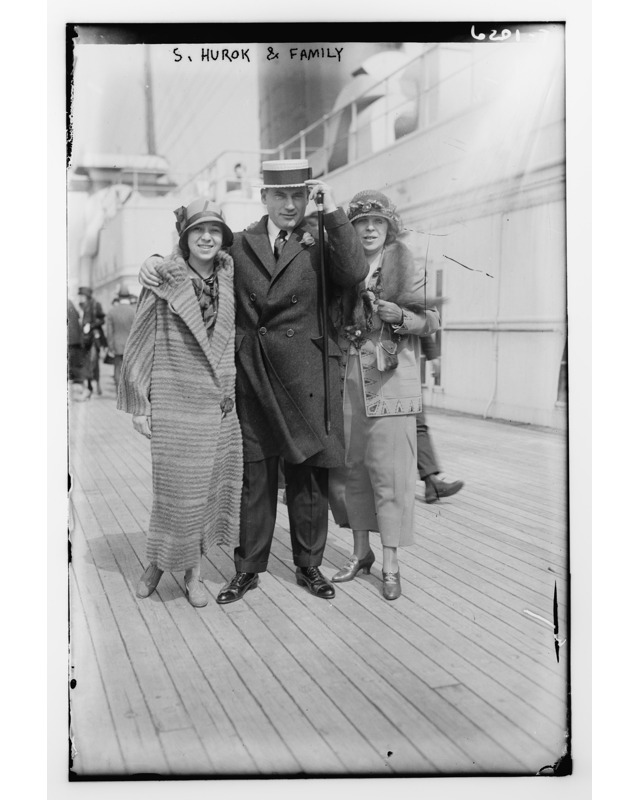
A separate NYPL collection, Fortune Gallo’s Ballet Russe business letters, supplies a bounded view of a management transition. Its description says Gallo succeeded Hurok in managing the Original Ballet Russe and documents arrangements to transport the company from Cuba to New York in early 1941. The collection includes correspondence, telegrams, legal materials, scheduling discussions, travel and hotel arrangements. That finding aid describes the surviving evidence; it is not a newly examined contract ledger, and Live Index does not derive payments or ticket grosses from it. This distinction matters when connecting Hurok’s career to the booking-agent explanation: artist or company representation, local venue management and international logistics are different responsibilities. The archival family photograph retains its complete composition because the caption identifies the family group rather than supplying an independently verified individual crop.
Career record
- 1930sNational Ballet Russe de Monte Carlo tours described in the Hurok finding aid.
- 1941Gallo collection documents the Original Ballet Russe transition and Cuba transport arrangements.
- 1949Sadler Wells touring cited in NYPL’s agency history.
- 1961 / 1964Kirov tour publicity preserved in the collection.
Entity relationships
Historical
Sol Hurok developed concert presentation through Hurok Attractions.
Related Live Index research and records
References and sources
- Hurok Attractions records, 1906–1974 — New York Public Library. Primary corporate source. Retrieved 2026-10-25.Cited for: Independent booking/promotion agency, international company tours, Kirov 1961/1964 publicity records.
- Fortune Gallo Ballet Russe business letters — New York Public Library. Primary corporate source. Retrieved 2026-10-25.Cited for: Original Ballet Russe management transition and early-1941 Cuba transport context; correspondence and logistics scope.