Research
The Independent Venue Paradox
Independent stages can create large spillover benefits for neighborhoods, workers and local businesses while retaining too little of that value to remain profitable. Economic impact and enterprise health are different measurements.
- Authors
- Published
- Updated
Conceptual framework · not measured data
Value created against value retained
The article separates the value an independent stage generates from the value it keeps. Each row names a benefit and identifies who captures it, which is the article's explanation for how a room can be economically important and financially fragile at once.
- Adjacent trade
- Attendees eat, drink and travel around the show.
- Neighbouring businesses.
- Employment
- Recurring work for technical and hospitality staff.
- Workers and the local labour market.
- District attraction
- A reason for people to be in the area at night.
- Property owners and the wider district.
- Artist development
- Early-career acts find their first audiences.
- Artists, and later the larger venues that host them.
- Ticket margin
- The operator's own revenue on the night.
- The operator, after costs — the article's point of fragility.
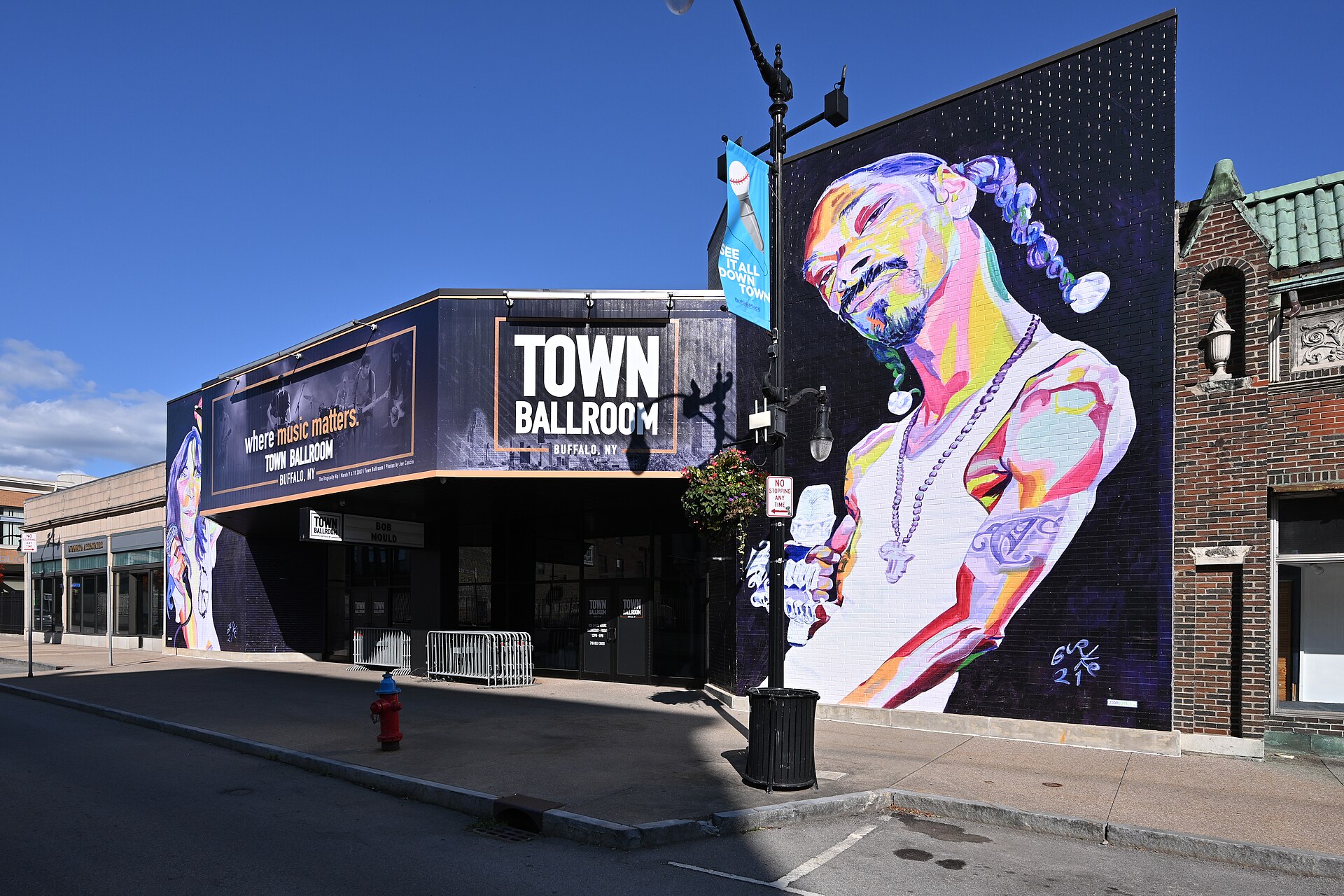

Independent venues occupy an unusual position in local economies because the value they generate and the value they capture can differ substantially. A venue pays the artist, staff, rent, utilities, insurance, security and production expenses associated with presenting a show. The audience created by that show may then spend money at nearby restaurants, bars, hotels, parking facilities and transportation providers. Those businesses benefit from the event without necessarily contributing to the venue's operating margin. The result is a classic positive-externality problem: an enterprise can be economically productive for its surroundings while remaining financially fragile itself.
The National Independent Venue Association's 2025 State of Live study provides unusually direct evidence of the contradiction. NIVA estimated that independent stages generated $153.1 billion in total economic output, contributed $86.2 billion to GDP, supported 908,000 jobs and generated $19.31 billion in federal, state and local tax revenue.1 At the same time, 64 percent of independent stages in the study were not profitable in 2024, and 22 percent reported struggling to stay in business.1 Those figures do not mean that every unprofitable venue generated positive local returns, but they demonstrate that sector-level economic contribution cannot be used as a proxy for firm-level health.
The distinction is familiar in public economics. A business captures private revenue through transactions in which it directly participates. Externalities occur when benefits or costs extend to parties outside those transactions. A concert venue can attract foot traffic to a commercial district, support adjacent food-and-beverage businesses and contribute to neighborhood identity. If those effects increase nearby property demand or visitor spending, the venue does not automatically receive a share of the resulting value.
This helps explain why cultural infrastructure can disappear even in neighborhoods that become more commercially successful. A small venue may help make an area desirable and then face higher rent as the area's desirability increases. The venue contributes to the amenity value that raises its own occupancy cost. The same pattern has been observed in other arts districts, where cultural producers act as early anchors and later encounter the real-estate consequences of successful placemaking.
The National Endowment for the Arts has long treated arts activity as part of creative placemaking and community development, and its Sound Places work explicitly frames music as a catalyst for public-space and community projects.2 At the national level, the Bureau of Economic Analysis reports that arts and cultural production accounted for $1.17 trillion, or 4.2 percent of U.S. GDP, in 2023.3 Those figures are much broader than independent music venues, but they reinforce the point that cultural production is an economic sector with measurable spillovers rather than an ornamental addition to the economy.
Venue economics are also unusually exposed to fixed costs. Rent, staffing, licensing and insurance persist even when a show underperforms. Artist fees are variable by event but can represent a major share of operating expense; NIVA reported that artist and booking fees accounted for 31 percent of expenses among respondents.1 A venue cannot indefinitely solve margin pressure by reducing artist payments without weakening the programming that generates demand in the first place.
The policy implication is not that every venue deserves subsidy. Some venues fail because programming is weak, operations are poor or local demand is insufficient. Economic-impact language can become a shield against ordinary market discipline if it is used without attention to causality. The more precise question is whether a venue produces documented spillover value that the market systematically fails to return to the operator, and whether preserving that venue generates public benefits large enough to justify intervention.
Possible responses vary. Cities can provide targeted cultural grants, property-tax treatment, zoning protection, noise-management frameworks, public-space partnerships or infrastructure support. Business improvement districts can recognize venues as foot-traffic anchors. Private developments can incorporate cultural tenants through favorable leases when those tenants increase the value of the larger project. None of these mechanisms should be automatic; each transfers value back toward an institution that may be producing benefits elsewhere in the system.
Measurement is essential because "economic impact" can be exaggerated. Spending by local residents may substitute for spending they would have undertaken elsewhere in the same city, and multiplier models can overstate benefits if they ignore leakage or displacement. Live Index will distinguish gross surrounding activity from net new regional activity, and both from the venue's own profitability. The fact that a restaurant sells more on show night is relevant to neighborhood economics but does not prove that the spending is entirely additional to the regional economy.
A venue-health index should therefore combine enterprise and ecosystem variables. Profitability, cash reserves, rent burden, utilization and closure risk describe the venue itself. Nearby visitor spending, employment, artist development and cultural participation describe broader effects. Keeping those categories separate allows policy makers to identify venues that are privately fragile but publicly productive without pretending that every cultural business creates the same external value.
The independent-venue paradox is not that venues are irrational businesses. It is that the market can price the private transaction while leaving some of the surrounding cultural and economic value unpriced. A rigorous live-music economy should measure both.
Research notes and limitations
NIVA's national study aggregates independent venues, promoters, festivals and performing arts centers in some headline measures. Local spillovers vary substantially by venue, neighborhood and visitor origin. Economic-impact analysis should not be used to infer net benefit without accounting for substitution and leakage.
References
- 01National Independent Venue Association, State of Live Economic Research Study, 2025. www.nivassoc.org/stateoflive
- 02National Endowment for the Arts, Sound Places Toolkit. www.arts.gov/sites/default/files/Sound-Places-Toolkit.pdf
- 03U.S. Bureau of Economic Analysis, Arts and Cultural Production Satellite Account, U.S. and States, 2023, April 2, 2025. www.bea.gov/news/2025/arts-and-cultural-production-satellite-account-us-and-states-2023
Publication record
The structured record for this document. Classification is drawn from the Live Index controlled vocabulary so relationships between people, subjects, places and measurements stay consistent across the platform.
- Content type
- Study
- Primary topic
- Venues
- Secondary topics
- Independent PromotersEconomic Impact
- Themes
- IndependenceEconomic ImpactMarket Health
- Economic concepts
- Economic ImpactFixed CostsDemandExternalities
- Measurements
- Live Index
- Methodology
- What we measure
Corrections and revisions
No corrections have been issued for this document. Substantive errors are corrected on this page, dated and retained.
Cite this research
- Plain
- Omar Afra, "The Independent Venue Paradox", Live Index, August 13, 2026, https://liveindex.io/research/independent-venue-paradox
- APA
- Afra, O. (2026, August 13). The Independent Venue Paradox. Live Index. https://liveindex.io/research/independent-venue-paradox
- Chicago
- Omar Afra. "The Independent Venue Paradox." Live Index, August 13, 2026. https://liveindex.io/research/independent-venue-paradox.
- BibTeX
- @online{research-independent-venue-paradox-2026, author = {Omar Afra}, title = {The Independent Venue Paradox}, organization = {Live Index}, date = {2026-08-13}, url = {https://liveindex.io/research/independent-venue-paradox} }